Cryptocurrencies are no longer anything new. In fact, they are popular enough nowadays that the numbers of people who want to invest in them and add them to their portfolios continues to grow. The best-known representative of this financial category is Bitcoin, the king of crypto and the blueprint for all the other crypto coins that emerged after it. But are the altcoins connected to BTC? The shortest answer is yes. Most altcoins move alongside Bitcoin and have a strong price correlation with it, which means that their prices often rise and fall at the same time.
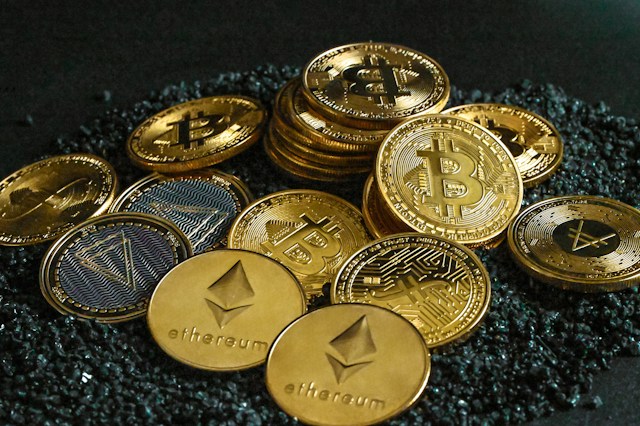
BTC is the oldest cryptocurrency in the world and the uncontested industry leader with a market cap that is considerably higher than that of Ethereum, the second-largest cryptocurrency. Owing to its dominant market share Bitcoin’s movements also end up dictating the overall direction of the crypto market. Historically, many exchanges needed users to trade altcoins using BTC pairs instead of regular cash, creating a direct financial link. That’s no longer the case but that doesn’t mean the connection between BTC and other cryptocurrencies is gone. In fact, many look into the changes and shifts occurring in the Bitcoin ecosystem before deciding how to buy XRP for example.
Bitcoin Dominance
There are many metrics that measure the state and sentiments associated with the crypto environment. Bitcoin Dominance is one of them, measuring the total share of Bitcoin’s total crypto market value. It changes as the money continues moving between BTC and altcoins. It is a market direction indicator, so when dominance levels are high it implies that investors are more confident in Bitcoin relative to other coins. This is particularly common during times of volatility or uncertainty, leading investors to see Bitcoin as safer because of its larger size and established reputation.
At the other end of the spectrum, when dominance is low it indicates that the traders are more willing to take risks on higher-reward holdings, despite the fact that the possibility of losses is typically also higher. Understanding crypto dominance can guide your decisions when it comes to portfolio diversification too, with high dominance meaning that you can consider moving into other cryptocurrencies without increasing risks. BTC was the first crypto as well so for a long time it dominated the market. However, as the market matures many other assets are evolving as well as developing their own unique use cases and features.
Traders look to Bitcoin Dominance as a means to determine what they should be investing in at a given time, so when the metric goes down, they can move their assets into altcoins and wait for them to provide higher returns too.
BTC season
Another concept that is important for traders is that of the Bitcoin season. When 25% or fewer of the top 100 cryptocurrencies outperform BTC over a 90-day period, investors call it Bitcoin season. It is a phase where Bitcoin dominates the price performance and captures the majority of the capital while the altcoins remain behind. It is tracked through altcoin season indexes, with a score between 1 and 100 determining the exact phase.
Readings that are 25 or lower indicate that a Bitcoin Season is currently in full swing. When the readings are at least 75 it is a sign of Altcoin Season. Recent market movements have hovered in the lower ranges, keeping close to the Bitcoin-favored territory through capital rotation into selective altcoins. This is most often observed ahead of major economic data releases. BTC dominance remains elevated during this phase too, as spot ETFs, institutional focus, and core liquidity center on BTC instead of spreading across smaller tokens.
The correlations
Let’s take XRP as an example. While a completely different digital asset than Bitcoin, it operates on an independent network but shares a price correlation and historical design inspiration. You can’t natively send Bitcoin across the XRP Ledger or vice versa; you’ll have to use a centralized exchange or external cross-chain wrapping services. BTC is designed as a store of value (hence its nickname: digital gold), while XRP was created to facilitate low-cost institutional cross-border payments. And yet, the two are connected to each other.
XRP’s price movements often go hand in hand with those that Bitcoin experiences. This is because BTC remains the dominant crypto asset and has the biggest say in the general market sentiment. XRP was originally conceptualized as “Bitcoin without the mining”. Massive shifts in Bitcoin impact XRP even though the asset is its own thing, with its own unique ecosystem. However, XRP can also move independently, based on regulatory developments or banking adoption news that impact it in particular.
This means that its price can begin to rally or drop even as that of BTC remains flat.
The ETF inflows
Exchange-traded funds have created ample conversations in the crypto world. They are hailed as a massive help for the ecosystem since they ushered in the era of institutional adoption. They are seen as safer since companies and enterprises don’t have to deal with the risk posed by cryptocurrencies but get to enjoy the advantages the market has to bring nevertheless. US-listed spot Ether and XRP exchange-traded fund inflow streaks ended at the beginning of September 2026, marking a reversal in the aftermath of sustained demand.
Ether ETFs recorded $48 million in net outflows in a single day, ending 12 consecutive days of inflows. Throughout the entire streak the fund attracted almost $2 billion. BlackRock led the outflows with more than $53 million, while the Fidelity Ethereum fund lost $26.2 million and the Grayscale Ethereum Staking ETF got a whopping $23.5 million. However, BlackRock’s staked ETHB partially offset the withdrawals with a neat $53 million in net inflows. The XRP exchange-traded funds posted $7.2 million in net outflows, ending an 11-session inflow streak.
It brought about $170 million, elevating the cumulative XRP ETF inflows to $1.68 billion. On the other hand, the Bitcoin ETFs moved in the opposite direction, with $101.2 million drawn after almost $240 million in net outflows during the earlier days.
If you’re an investor, keeping an eye on the market is always important. Remember to think your strategies through so that you make the best possible choices for your portfolio at all times.