Ant Group has open-sourced LingSante, the medical AI model family that powers its health app Afu – a service with 150 million users that handles nearly 20 million health consultations every day. Released on November 23, 2026, the weights of the first two models are now free to download, and the practical details — model sizes, hardware requirements, and what already ships in the app — are worth a close look for anyone following AI on consumer and workstation hardware.
Two Open Models, in Plain Numbers
LingSante-3.1-air-VL — 124 billion total parameters, 5.5 billion active per token. A lightweight, natively multimodal model that reads text, images and video. It handles medical image understanding, skin-condition analysis, diet and nutrition assessment, and medical report interpretation. The low active-parameter count is what keeps it efficient for on-device and localized deployment.
LingSante-3.1-flash — 560 billion total parameters, roughly 25 billion active per token, with a context window of up to one million tokens. This is the deep-reasoning model for heavy lifting: medical knowledge understanding, evidence-based retrieval and long-horizon workflow execution for complex case analysis and medical agent scenarios.
Both are live on Hugging Face now, alongside specialized family members: LingSante-Pulse (health-risk prediction covering more than 150 conditions), LingSante-MedGuard (a safety model for medical safety, compliance and bioethics risks) and LingSante-Live (the real-time multimodal agent behind AI video consultations).
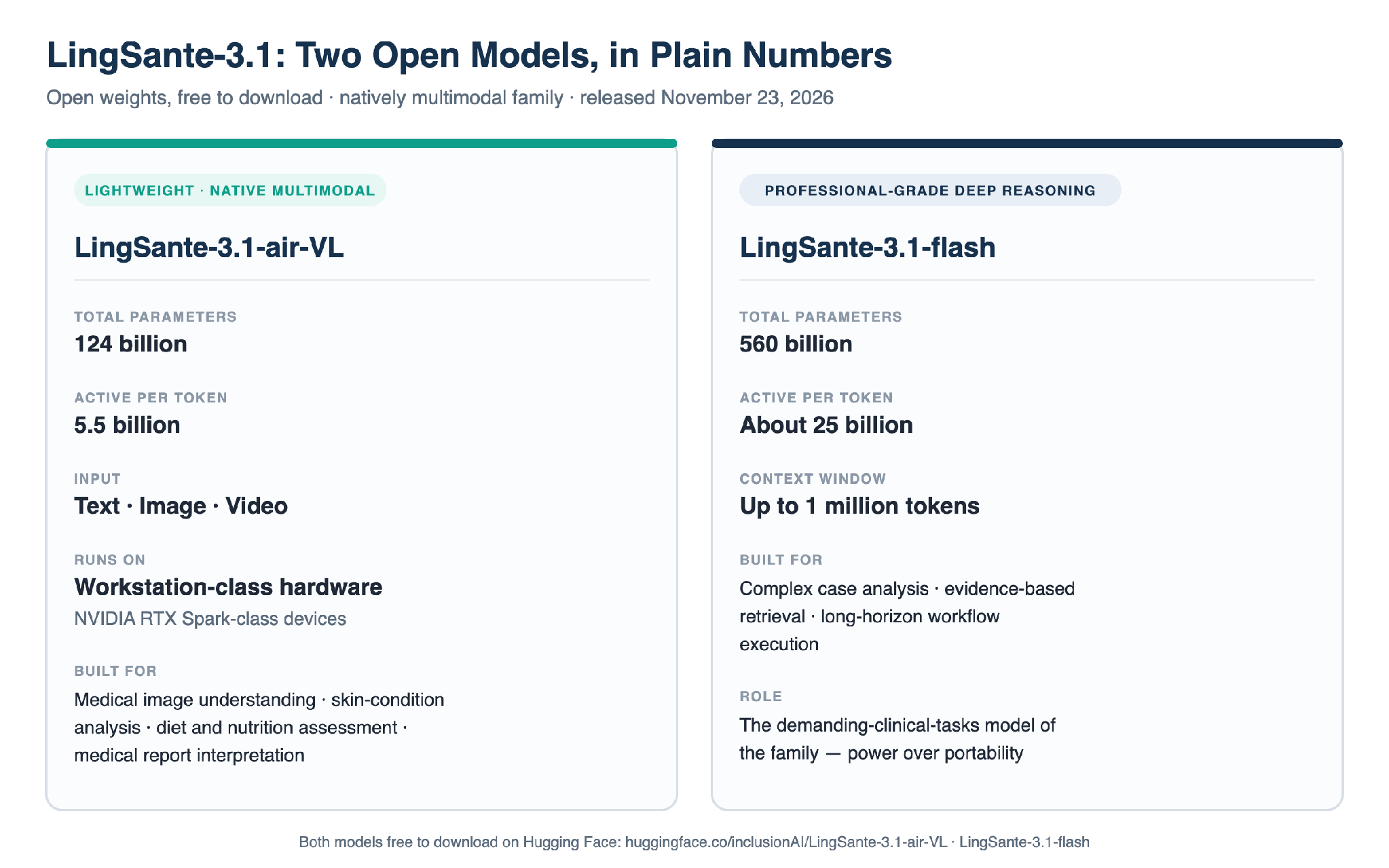
LingSante-3.1-air-VL and LingSante-3.1-flash, side by side: parameters, active parameters, context window and intended use.
Runs on a Desk, Not in a Data Center
The headline for hardware watchers: at 5.5 billion active parameters per token, LingSante-3.1-air-VL is designed to run on workstation-class machines such as NVIDIA RTX Spark-class devices. That means a small clinic or a medical research team can deploy specialist-grade medical AI on premises — no cloud contract, and patient data never leaves the building. For institutions that have stalled on AI adoption over data privacy, open weights plus edge hardware removes the most common objection.
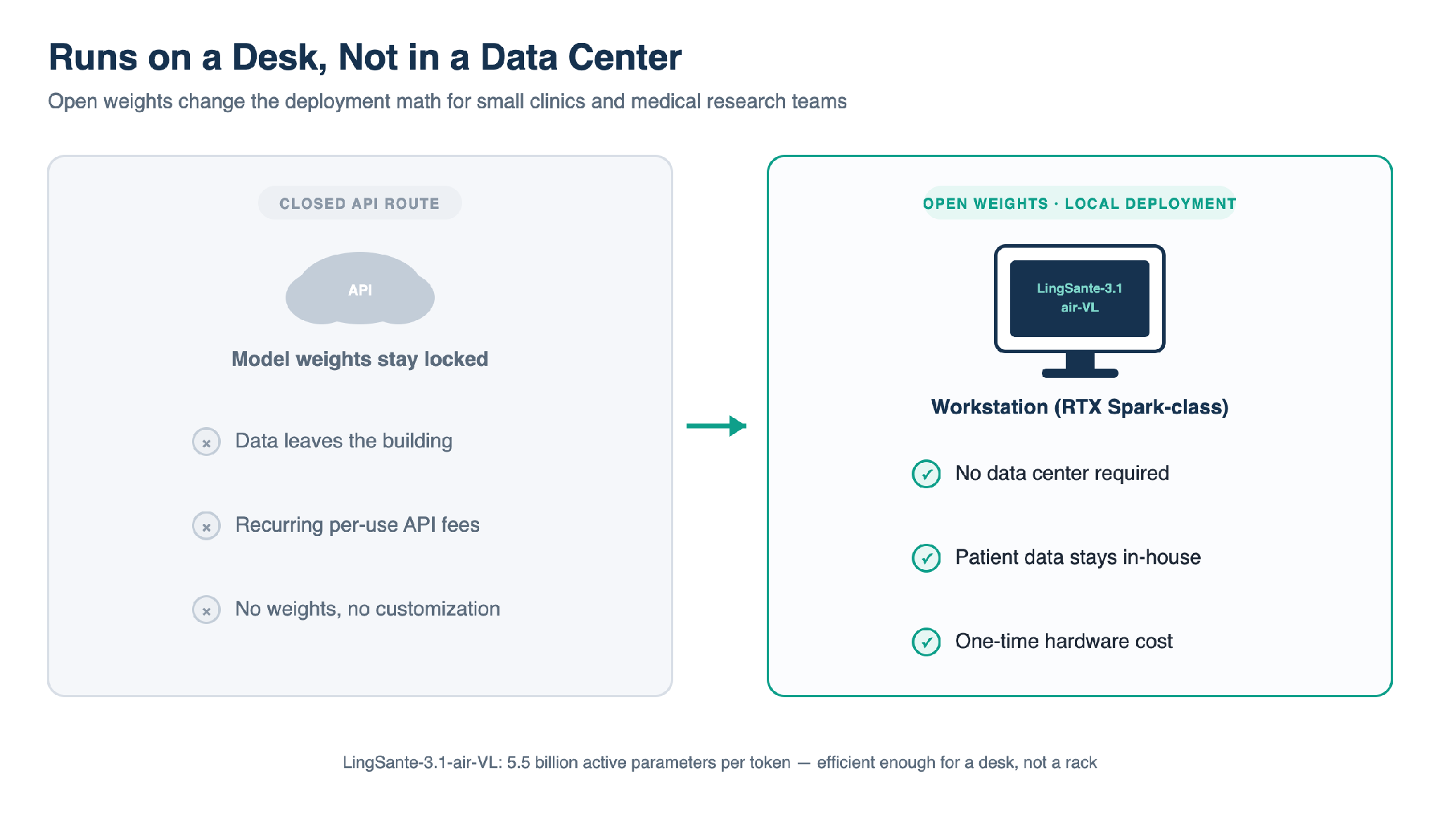
Open weights on workstation-class hardware: edge deployment keeps patient data and costs in-house.
It also signals where consumer health hardware is heading. If a 124-billion-parameter multimodal medical model can run on a workstation today, the same architecture family is a plausible candidate for future local deployment in smart health devices.
Inside the Afu App
The upgraded Afu app shows what the models do in production. Its new real-time AI video consultations address the classic weakness of text-based symptom chat: over video, Afu can visually assess symptoms, examine physical conditions and review medicines and medical reports. By analyzing facial blood-flow changes captured on camera, it can also estimate indicators such as heart rate and breathing rate. Users who want professional sign-off can bring an online doctor into the call — Afu’s doctor-review service covers 16 medical specialties.
The AI Health Manager has also grown beyond Q&A, taking on roles such as AI weight-loss coach, nutritionist and parenting assistant. It builds tailored plans from the user’s personal health profile, sends proactive reminders, and connects with smart health devices across eight categories — including the newly launched Afu AI health band and AI health ring.
What Builders Get
For developers, the open release means building medical applications on weights that are already validated in a production service at 150-million-user scale — a contrast with research-only medical models. Growth has been steep, too: Asia Tech Times noted that Afu climbed from 100 million users in February 2026 to 150 million by the November release. Ant Group’s stated position is that AI assists doctors rather than replacing them, and the imaging-report capability is explicitly research-only.
For a market saturated with general-purpose assistants, a health-specific, open-weights, edge-deployable model family is one of the more concrete releases of the year.