Revopoint is officially introducing the POP 4, a versatile all-rounder designed for creators, 3D printing enthusiasts, product designers, VR/AR developers, car modifiers, and heritage preservationists who need a compact scanner that can handle many different scanning situations.
The biggest feature of the POP 4 is its hybrid blue-and-infrared light scanning system. Instead of depending on just one scanning method, the POP 4 supports 5 scanning modes: Full-Field HD Scanning, VCSEL Rapid Scanning, Hybrid HD Scanning, 30-Cross Blue Laser Lines Scanning, and Single-Line Deep Hole Scanning. This gives users more flexibility when working with different object sizes, surface types, and environments.
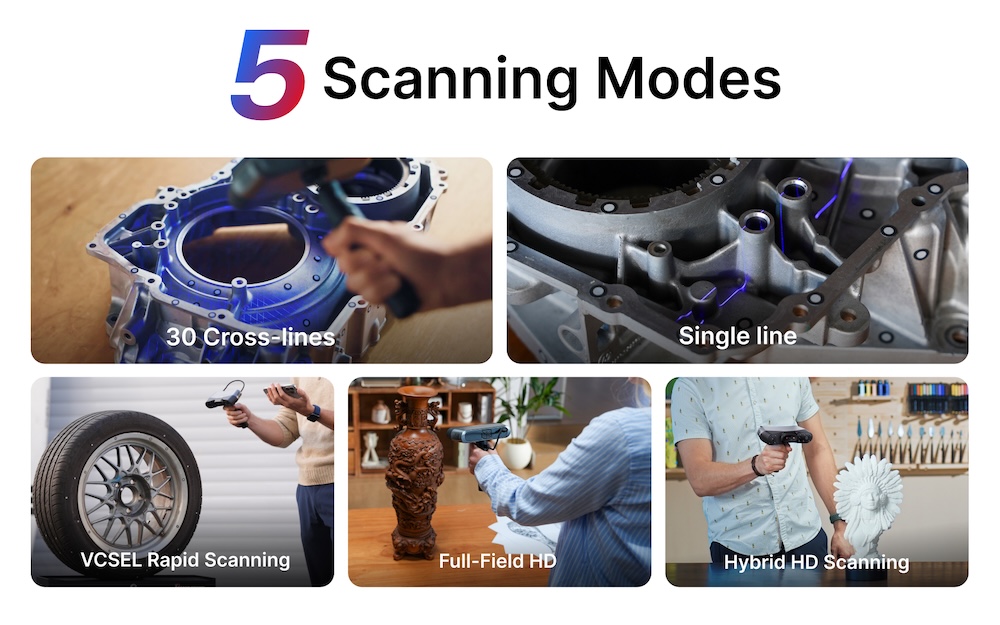
For example, Full-Field HD Scanning is useful for capturing detailed point cloud models, while VCSEL Rapid Scanning is designed for smoother and faster data acquisition. Hybrid HD Scanning combines speed and detail for high-quality surface modeling. The 30-cross blue laser mode is especially helpful for dark or reflective objects, including shiny metal surfaces that can be difficult for many scanners to capture. The single-line deep hole mode is made for narrow areas such as grooves, holes, and tight spaces where standard scanning methods may struggle.
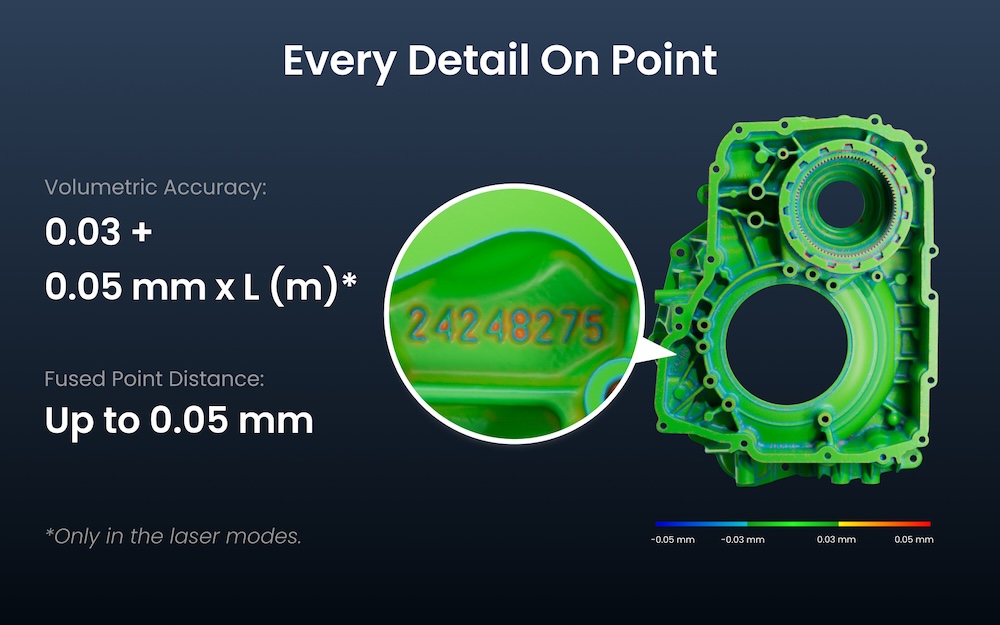
In terms of performance, the POP 4 offers impressive specifications for a scanner in this category. In multi-line laser mode, it can reach a volumetric accuracy of 0.03 mm + 0.05 mm × L (m), which is great for 3D printing, reverse engineering, and precision modeling. It also supports a fused point distance of up to 0.05 mm, which is helpful to preserve fine surface detail. Scan speed reaches up to 105 fps in multi-line laser scanning mode when used with an NVIDIA GPU, which should make handheld scanning feel smoother and more efficient.
Another major advantage is outdoor usability. The POP 4 is designed to scan in bright environments, including lighting conditions of up to 100,000 lux in supported modes. That means you can use it for outdoor projects such as scanning automotive parts, construction elements, archaeological objects, or large items. For users who often work outside a controlled studio, this is a very useful upgrade.
Revopoint also adds smart software features to improve the workflow. With Real-Time AI Object Segmentation & Tracking, the POP 4 can help users focus on the areas they actually want to capture. This reduces unnecessary background data, saves editing time, and can improve overall scan accuracy. The scanner also introduces Photorealistic 3D Gaussian Splatting Modeling, allowing users to create highly realistic 3D models and export them in Splat format.
I’m also quite impressed with its portable design. It supports handheld and desktop scanning and weighs just 286 g. With the included 5500 mAh battery grip, users can scan wirelessly with a phone or tablet for around 4 hours under average power consumption. It supports Windows, macOS, Android, and iOS, and can export files in common formats such as PLY, OBJ, STL, ASC, 3MF, GLTF, FBX, and Splat. That makes it useful for both traditional 3D printing workflows and newer digital modeling applications.
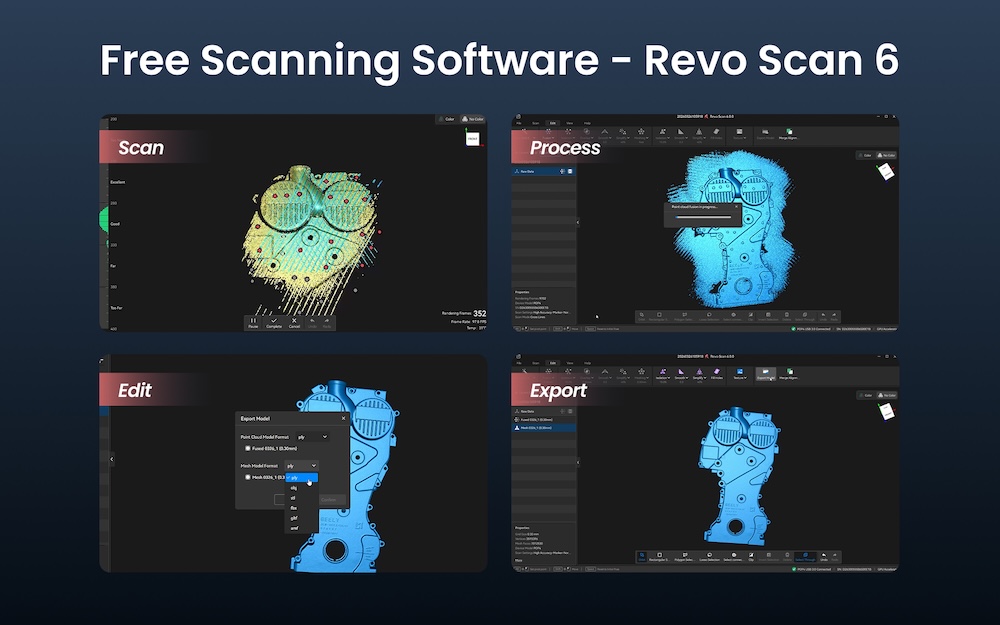
You can scan in Revo Scan, then move data with one-click import into Revo Measure for professional measurement or Revo Design for reverse engineering. This scan-to-process-to-design workflow can save time for users who need accurate models for analysis, modification, or production.
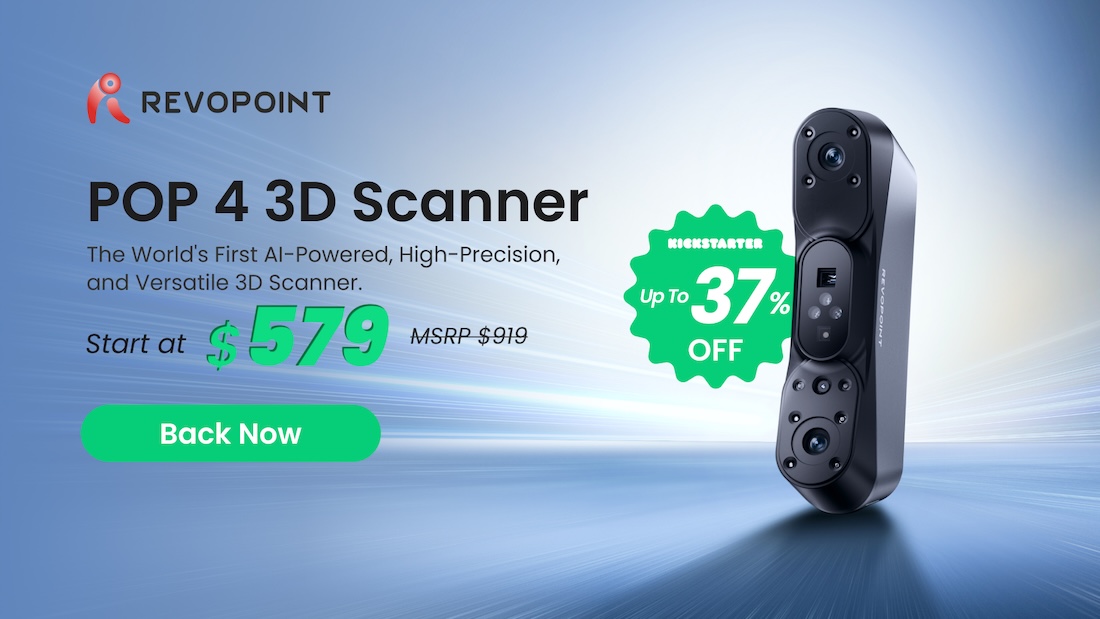
Overall, the Revopoint POP 4 looks like a capable and flexible 3D scanner for prosumers who want one device for many tasks. It is launched on Kickstarter with a limited 37% off Super Early Bird discount, so you can back the project starting at just $579.