Community Wi-Fi can extend where a mobile service carries data without adding another cellular tower. It provides another route through independently operated access points, rather than strengthening the cellular signal. The phone uses a local Wi-Fi radio link, and the access point passes its traffic onward through an internet connection. This is called Wi-Fi offloading: traffic uses a participating access network instead of taking the cellular radio route to the internet. Turning separate installations into a service for mobile subscribers requires more than equipment in the right places, however. Participating networks need to recognize eligible devices, authorize connections, and decide whether the available Wi-Fi meets the operator’s requirements.
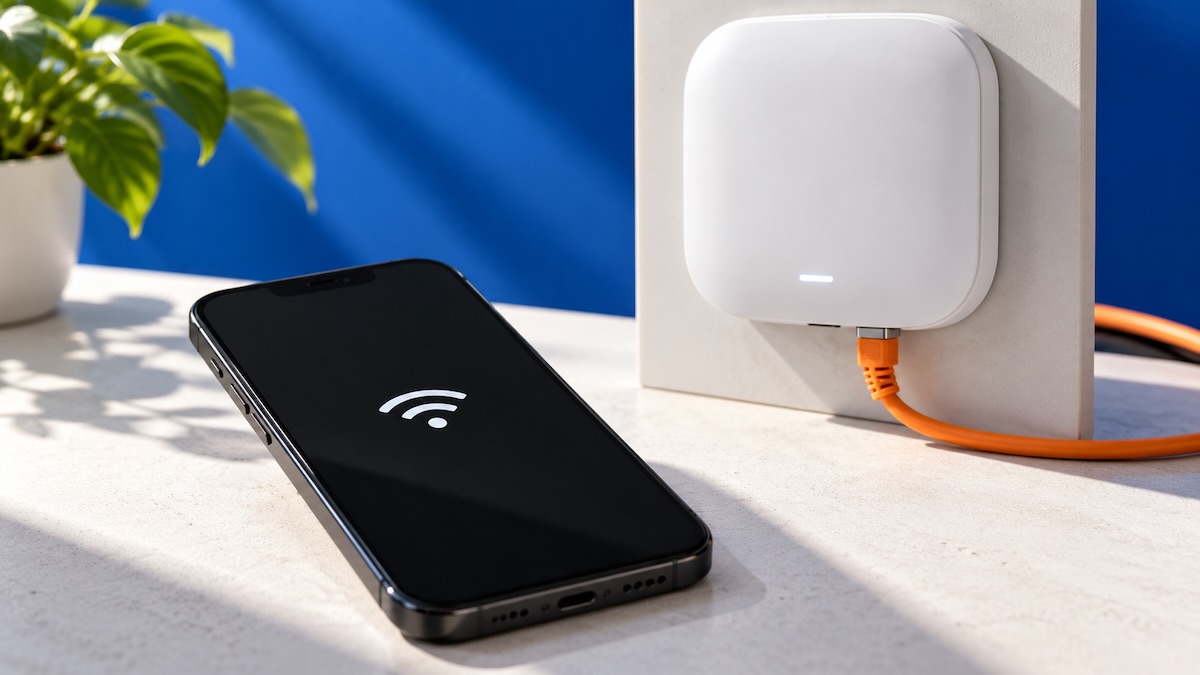
Helium provides a working example of this distributed approach. In its June 2026 network update, the project describes infrastructure deployed and operated by participants that carries traffic for partner mobile carriers. Local contributions supply wireless coverage, while carrier relationships connect that infrastructure with subscribers. The Helium Network is the infrastructure platform in this arrangement, distinct from a retail mobile subscription. Ownership of an access point and the subscriber’s relationship with a carrier serve different purposes.
Coordinating contributions to physical networks is part of the wider crypto and Web3 discussion covered by a crypto and Web3 publication called AlphaWire. The site covers current news about developments in this space, which is often pushing the boundaries of existing technology and creating new approaches to solve modern problems. For community Wi-Fi, that coordination sits alongside conventional networking: identifying subscribers, admitting devices to suitable access points, and carrying internet traffic. Understanding more about the larger Web3 goals can be a very useful starting point for grasping how this concept works and why it’s valuable to users today.
How a Phone Joins Participating Wi-Fi
Automatic roaming helps independently operated Wi-Fi platforms serve users whose subscriptions come from elsewhere. Passpoint supports automated onboarding, while OpenRoaming connects participating identity providers and access networks. The Wireless Broadband Alliance explains this relationship in its Access Network Metrics article, published in March 2026. An identity provider is the organization responsible for recognizing the user’s credentials; a mobile operator can perform that role. An eligible device can use recognized credentials instead of a separate manual guest login at each participating hotspot.
The access network supplies the local wireless connection. The identity provider decides whether the subscriber is entitled to use it. Those responsibilities can belong to separate organizations because roaming arrangements establish how they communicate and recognize each other. A carrier therefore does not have to own every participating access point to authorize its subscribers’ use of the network.
Behind that decision is an AAA server, short for authentication, authorization, and accounting. Authentication establishes identity, authorization determines access, and accounting records network use. These functions concern the subscriber’s permission to connect. They are separate from the access point’s job of exchanging data over Wi-Fi.
A visible network name alone does not establish eligibility. The device, its credentials, the access network, and the identity provider must support the relevant arrangement. Community deployment describes who contributes the equipment; roaming describes how another organization’s subscribers gain access. Neither term means that every nearby phone can join every access point.
Checking Wi-Fi Quality Before Connecting
An operator can recognize a subscriber without knowing how well the local Wi-Fi connection is performing. Distributed infrastructure therefore creates two separate questions: who is allowed to use an access point, and whether its current radio conditions meet the operator’s criteria.
Access Network Metrics, or ANM, provides a means of sharing performance information during the connection decision. In the WBA’s account of a demonstration in Paris on October 13, 2025, network measurements reached the identity provider through an authentication proxy, an intermediary that forwarded the measurements to its server. The operator rejected the attempted connection while the received signal strength indicator, or RSSI, remained below a defined minimum. When it improved sufficiently, the device was accepted.
The operator received information about the local radio condition while deciding whether to admit the device. RSSI measures received signal strength, so accepting a connection on that basis does not establish its internet speed or every other aspect of performance.
Sending these measurements required an authentication proxy in the Paris setup. The WBA describes work to let access points supply metrics directly. Operators and equipment must implement the capability; it should not be assumed across all carriers or installations.
Where Web3 Coordination Fits
The Web3 element concerns organizing participation in the infrastructure. Here, blockchain-based token activity connects contributions from separate deployers with use of the shared network. Helium describes HNT as a network utility token: deployers carrying carrier traffic receive it, while carriers using the network burn it. Burning removes tokens from circulation. This connects the token’s stated role to infrastructure contributions and network use, without making it the mechanism that transmits a phone’s data.
Distributed deployment changes who supplies those links, while operating them remains a physical task. Each access point needs a working radio and an onward internet connection. Its placement determines where that local wireless link can reach. Token activity coordinates participation in the network; subscriber credentials and carrier authorization serve a different purpose, establishing access to the service.
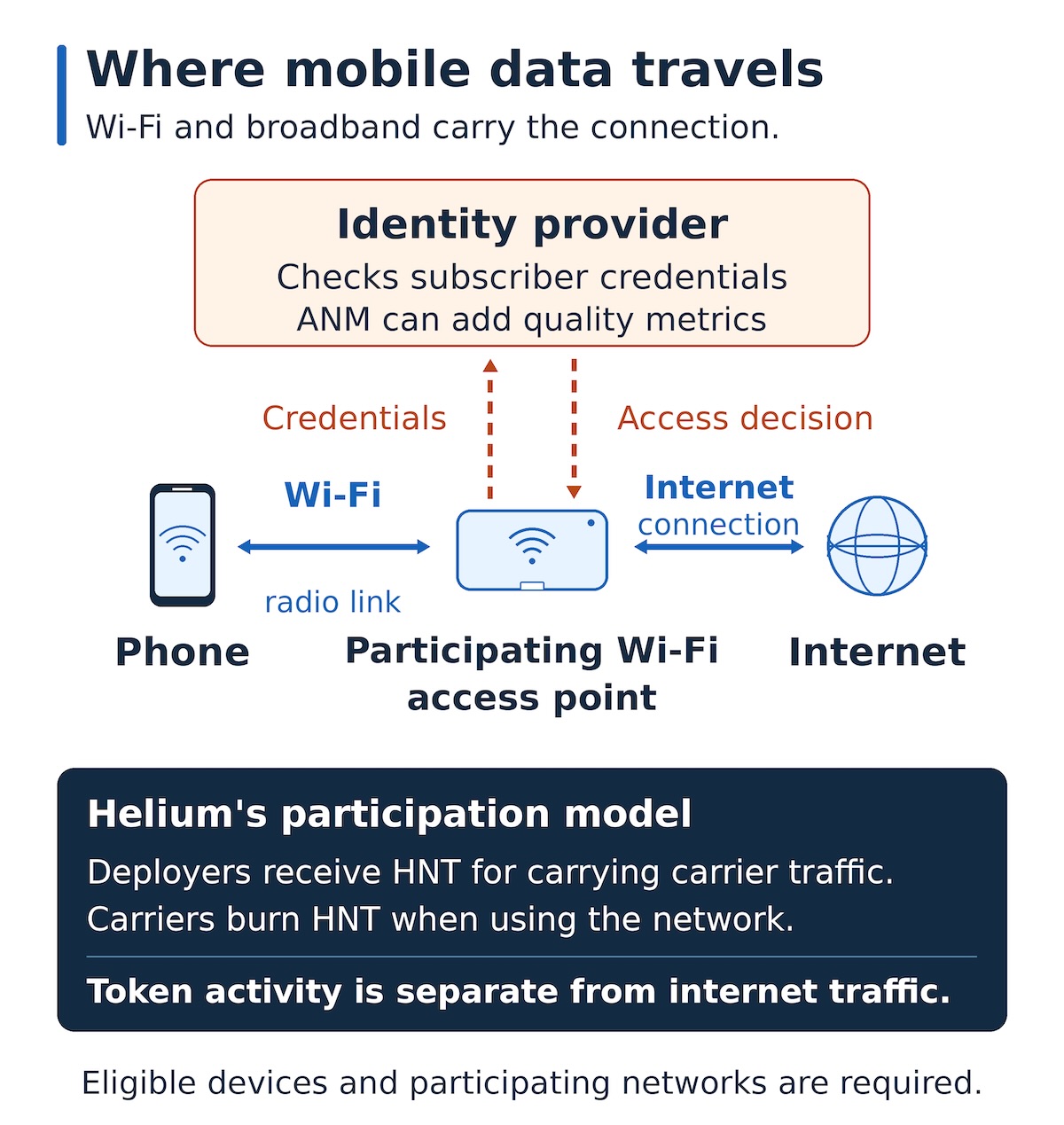
An independently operated access point becomes part of a mobile service through these relationships, even though the subscriber’s carrier does not own it. The phone reaches the internet over a local Wi-Fi link, with access authorized through the participating identity provider. Adding more infrastructure can broaden the available footprint, while roaming and connection decisions determine which installations subscribers can actually use. The result is another route for mobile data through coordinated, separately operated equipment.