At Astravolt’s recent event in Silicon Valley, the young energy startup used its North American debut to argue that batteries themselves are about to become intelligent, networked infrastructure.
Founded in 2023 on the philosophy of “AI + Robotics + Digital Energy,” Astravolt is challenging the notion that energy storage is just metal boxes quietly charging in the corner. The company’s executives framed their approach around what they call “Active Intelligence”, a system in which batteries and power hardware do not just sit and wait to be discharged, but sense, predict, and respond to how people and cities actually use electricity.
“Energy storage has historically operated as isolated, passive hardware,” said Kenneth Jing, a technical expert at Astravolt, during the launch event. “Our vision is to transform these systems into intelligent, connected devices that learn usage patterns, predict demand, and optimize performance over time. We’re applying the same AI and cloud principles that revolutionized smartphones and computing to energy infrastructure.”
Using Silicon Valley as a Stage for a Bigger Story
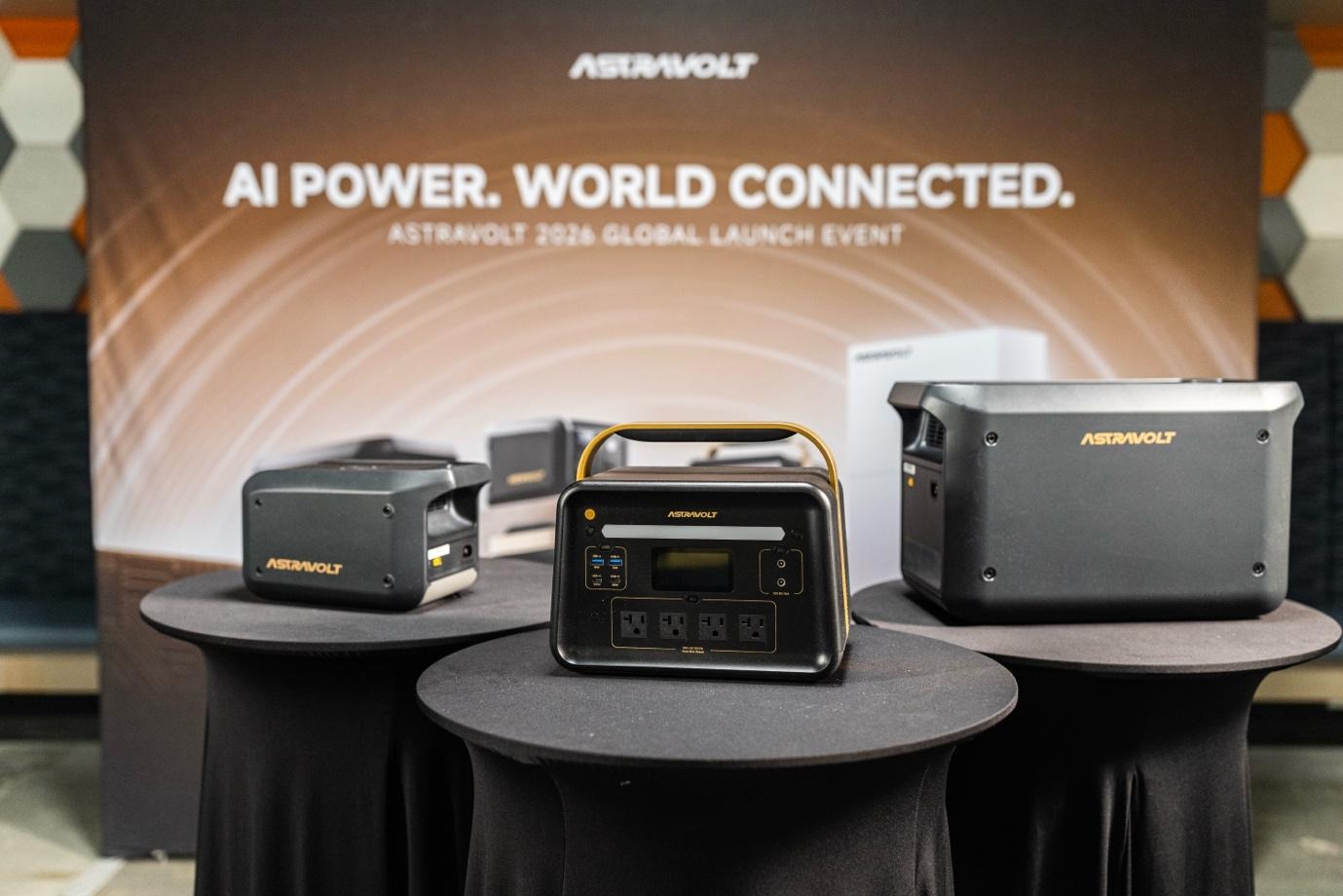
The launch event itself doubled as a live case study in how Astravolt wants to be perceived: less as a device maker, more as an ecosystem builder. The company did bring hardware, its Nova portable power stations were on display, but they were treated as entry points into a broader all-scenario energy story rather than the main headline.
That story is organized around four layers of everyday life: personal mobility, residential energy, and community and urban infrastructure. Astravolt’s pitch is that these layers can be stitched together by a single cloud management system, turning what used to be scattered devices into a coordinated energy network.
Personal Mobility: The On-Ramp
The first layer starts with portable power, which Astravolt frames as the on-ramp into its ecosystem. The Nova series is pitched less as a set of gadgets for camping and road trips and more as “intelligent companions” that learn how their owners actually use energy off-grid.
In practical terms, these units anchor the user’s relationship with the brand and also become the mobile nodes of a larger energy loop that increasingly follows the user from car, to home, to city.
Residential Energy: The “Home Energy Brain”
From there, the narrative moves into the home. Astravolt’s APOLLO balcony systems and HALO home batteries are the “home energy brain”, a layer that upgrades households from passive bill payers to active energy managers.
Rather than dwelling on kilowatt-hours and inverter specs, the company stresses what this means in daily life: a balcony unit that quietly turns sunlight into usable power without heavy installation, an AI system that shifts charging into off-peak hours to lower bills, and a battery that keeps the lights on when the grid flickers. Together, these components form a small, software-coordinated microgrid that aims to deliver a familiar trio of benefits: cost savings, backup resilience, and a smaller carbon footprint.
Community and City: From Devices to “Virtual Power Plants”
The most ambitious part of Astravolt’s narrative lives at the community and city level. Once personal and home systems are in place, the company argues, the same AI layer can begin to treat those scattered batteries as a single pooled asset, a “virtual power plant” that can help support local grids.
In that scenario, home batteries are no longer just private backup; they can respond to city-level signals, exporting power or reducing demand during stress on the grid. Astravolt presents this as a shift from energy as private equipment to energy as a shared resource that circulates within neighborhoods and across urban networks.
The Robotic Piece That Closes the Loop
To make that vision tangible, Astravolt points to HELIOS, a mobile storage and charging robot now in development. Instead of drivers hunting for available chargers, HELIOS is designed to do the opposite, “chargers finding vehicles” in parking structures, depots, and other dense environments.
Equipped with autonomous navigation and high-power charging capability, the robot is pitched as a kind of roaming energy buffer: for drivers, a convenient way to get charged; for cities, a mobile tool for smoothing peaks without pouring concrete for more fixed infrastructure. In Astravolt’s ecosystem map, HELIOS is the piece that physically moves energy to where it is needed most, extending the company’s logic of “active intelligence” out into the streets.
Why This Matters Now
Behind the marketing phrases, Astravolt is tapping into a real tension in today’s energy transition. As more households install solar, as electric vehicles spread, and as portable power stations become cheaper, energy consumption is fragmenting across millions of small devices. That fragmentation brings resilience, but it also makes coordination harder.
“We’re building the connective infrastructure for distributed energy,” Jing said. In other words, Astravolt is betting that the next phase of the energy story is not just about adding more batteries to the world, but about making them talk to each other.
The Silicon Valley event was its first major outing in North America, and the narrative it chose to tell at launch is clear: Astravolt does not just want a seat at the portable power table; it wants to convince the market that intelligence, not just capacity, will define the next generation of energy systems.